Classroom · Airspace
Airspace, Explained: Classes A–G for Pilots
The U.S. airspace system looks like alphabet soup until you see the logic behind it: the busier and more complex the traffic, the tighter the control — and the earlier a letter in the alphabet. This lesson builds airspace from the ground up. We map every class by altitude, show exactly what you need to enter each one, decode the weather minimums and equipment rules that come with it, teach you to read airspace straight off a sectional chart, and finish with worked examples that turn a route line into a checklist — an original diagram for every idea.
Why airspace is organized this way
Airspace is not carved up arbitrarily. Every class exists to match the level of air traffic control service to the density and complexity of the traffic in that chunk of sky. Where jets converge on a major hub, control is strict and the entry bar is high; over open country at low altitude, you can fly with almost no oversight at all. The letters run roughly from most controlled to least: Class A is the tightest, Class G is uncontrolled. There is no Class F in the United States.
Two big buckets sit underneath the letters. Controlled airspace (A, B, C, D, and E) is airspace where ATC provides at least some service and where specific rules — clearances, communication, equipment, and weather minimums — apply. Uncontrolled airspace (G) is where ATC neither separates nor is required to talk to VFR traffic. “Controlled” does not mean ATC is watching you personally at all times; it means the airspace carries a defined set of requirements and services. Learn the requirements once, per class, and any chart becomes a set of instructions you simply read off.
Key idea The class of airspace tells you three things at a glance: what you need to get in (clearance vs. two-way comms vs. nothing), what equipment you must carry (radio, transponder, ADS-B), and how good the weather must be to fly VFR. Everything else is detail.
The big picture: airspace by altitude
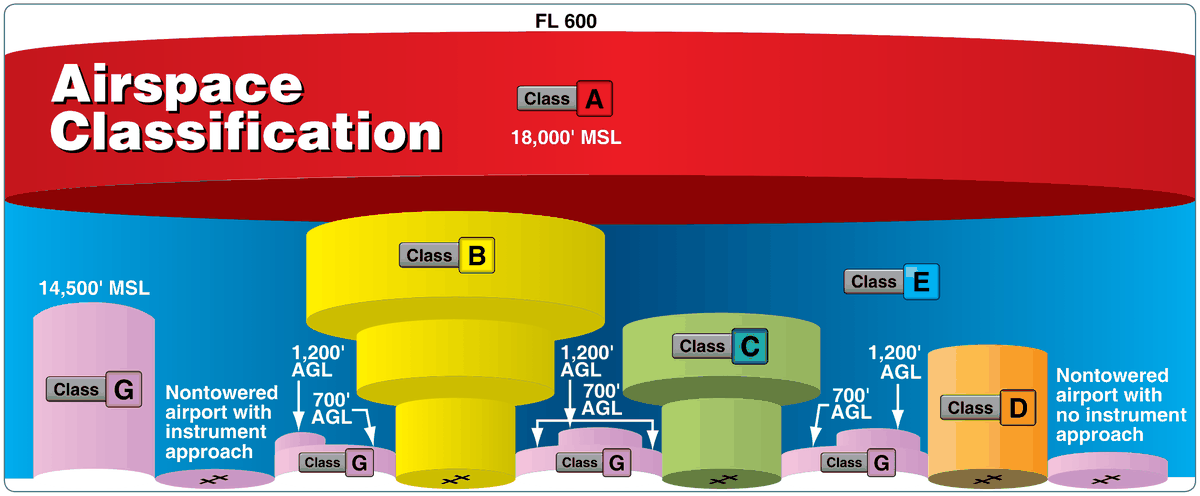
Before we take the classes one at a time, it helps to see them stacked together. This cross-section shows where each class lives in the vertical. Class A is a lid over the whole country from 18,000 ft up. Class E fills most of the controlled airspace beneath it. And around busy airports, terminal airspace — B, C, and D — rises up from the surface like towers of different heights. Class G hugs the ground wherever controlled airspace hasn’t reached down to meet it. We color-code the classes here and reuse the exact same colors in every diagram, table, and worked example that follows.
| Class | Where / vertical extent | To enter (VFR) | Pilot / equipment |
|---|---|---|---|
| A | 18,000 MSL up to & incl. FL600, nationwide | IFR only — no VFR | Instrument rating + ATC clearance |
| B | Busiest hubs; surface to ~10,000 MSL | Explicit ATC clearance (“cleared into the Bravo”) | ≥ Private (or endorsement); radio, Mode C, ADS-B Out |
| C | Tower + radar; surface to ~4,000 AGL | Two-way radio comm established | Radio, Mode C, ADS-B Out |
| D | Tower, no radar; surface to ~2,500 AGL | Two-way radio comm established | Radio |
| E | Controlled airspace that isn’t A/B/C/D | No clearance for VFR | Varies by altitude (see below) |
| G | Uncontrolled; surface to overlying E floor | Nothing required | None specific to the airspace |
Class A: the high-altitude IFR world
Class A is the simplest class to describe and the strictest to enter. It spans from 18,000 ft MSL up to and including FL600 (60,000 ft on a standard altimeter setting) across the entire contiguous United States and out to 12 NM off the coasts. Because everything at those altitudes is fast, high-performance traffic on airways and jet routes, Class A is flown under IFR only. There is no VFR flight permitted in Class A at all.
To operate in Class A you must hold an instrument rating (or be under the supervision of an appropriately rated instructor on an IFR clearance), be on an IFR flight plan, and have received an ATC clearance before entering. Above 18,000 ft everyone sets their altimeter to the standard 29.92 inHg and altitudes are expressed as flight levels — FL180, FL350, and so on. For most piston pilots, Class A is simply the ceiling you stay below; you meet it the day you earn an instrument rating and start filing into the flight levels.
Note the boundary The floor is 18,000 ft MSL and the top is FL600 inclusive — FL600 itself is inside Class A. Class E picks up the controlled airspace below 18,000; above FL600, you’re back into Class E again. Convert a pressure setting into the altitudes that matter with the pressure altitude calculator.
Class B: the upside-down wedding cake
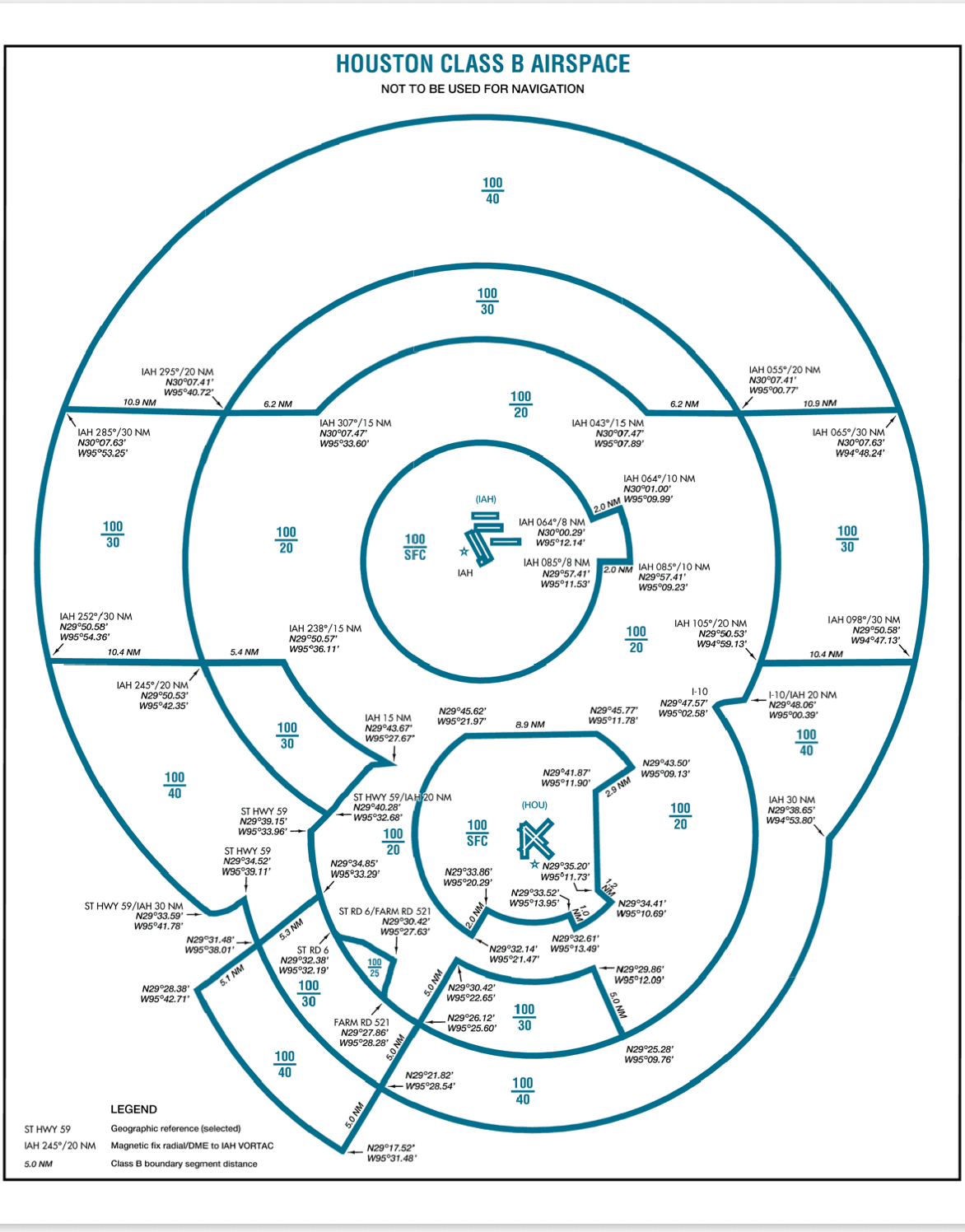
Class B surrounds the nation’s busiest airports — think Atlanta, Los Angeles, Chicago O’Hare, New York. It generally extends from the surface up to around 10,000 ft MSL, and its most recognizable feature is its shape. Seen from above it’s a set of concentric rings; seen from the side it looks like an upside-down wedding cake — a small core reaching the ground at the primary airport, with wider shelves stacked above and around it, each shelf’s floor stepping up as you move outward. This keeps the protected airspace tight to the ground near the runways while flaring out at altitude to capture arriving and departing jets.
Getting in: you must be cleared
Class B is the one class where talking to ATC is not enough. You must receive an explicit clearance containing the words “cleared into the Class Bravo” (or “cleared into the Bravo airspace”) before you cross the boundary. A simple radio exchange, a traffic advisory, even “maintain VFR” — none of those authorize entry. If you have not heard the word cleared paired with Bravo, you stay out. This is the single most-tested Class B fact, and the one most likely to become a pilot-deviation report if you get it wrong.
Equipment and pilot requirements
To act as pilot in command in Class B you must hold at least a private pilot certificate, or be a student, sport, or recreational pilot who holds the specific endorsement for that Class B airspace (a logbook endorsement from an instructor). There is an important exception: student-pilot solo flight is prohibited at roughly a dozen of the very busiest Class B airports, which are named explicitly in 14 CFR 91.131. At those fields, a student simply cannot solo into the Bravo no matter what endorsement they carry.
Do not confuse “Contact approach” or being handed a squawk code is not a Class B clearance. Only the phrase “cleared into the Class Bravo” lets you enter. If in doubt, ask — and remain clear until you hear it.
Class C: two-way communication established
Class C surrounds airports that have an operating control tower, are served by radar approach control, and handle a moderate volume of traffic — busy, but a step below the Bravo hubs. The standard Class C shape is two nested cylinders: a 5 NM-radius inner core that runs from the surface up to about 4,000 ft AGL, wrapped by a 10 NM-radius outer shelf that runs from 1,200 ft AGL up to 4,000 ft AGL. Altitudes on the chart are shown in MSL, but the design intent is roughly surface-to-4,000 above the field.
The magic words: “established”
Class C does not require a clearance the way Bravo does. Instead it requires two-way radio communication to be established with the controlling facility before you enter. “Established” has a precise meaning: it happens the moment the controller replies using your call sign. If you call “Springfield Approach, Cessna 34567…” and the controller answers “Cessna 34567, Springfield Approach, standby,” communication is established — you may enter. But if the controller says “aircraft calling, standby” without your call sign, communication is not established, and you must remain clear of the Class C until they come back to you by call sign.
The test Two-way communication is established when ATC answers with your call sign. “N34567, standby” = established, go ahead. “Aircraft calling, standby” = not established, stay out.
Equipment-wise, Class C requires a two-way radio, a Mode C transponder, and ADS-B Out — the same avionics load as Class B. There is no minimum certificate level beyond the usual student-with-instruction rules; a properly endorsed student pilot can operate into Class C.
Class D: a tower without radar
Class D surrounds airports that have an operating control tower but no radar approach control of their own — smaller towered fields. A Class D typically extends from the surface up to about 2,500 ft AGL within roughly a 4 NM radius, though the exact shape is tailored to contain the airport’s instrument approaches and often has cut-outs and extensions drawn to fit them. Like Class C, entry requires that two-way radio communication be established with the tower before you enter — the same “answers with your call sign” rule applies.
Class D is deliberately light on requirements: you need a two-way radio and nothing more in the way of transponder or ADS-B for the Class D itself (though overlying or nearby airspace may still demand them). When the tower closes for the night, the airspace often reverts to Class E or Class G, and the requirements change with it — something the chart and the airport’s notes will spell out. Because it’s the friendliest towered airspace to operate in, Class D is where most students first learn to work a control tower.
Shape follows the approaches Don’t expect a clean circle. Class D boundaries are drawn to protect the instrument procedures at that specific field, so you’ll see keyholes, notches, and arms extending along final approach courses. Read the dashed-blue outline on the sectional, not a mental circle.
Class E: the controlled airspace that fills the gaps
Class E is all of the controlled airspace that isn’t A, B, C, or D. It’s by far the most common controlled airspace — the vast majority of the sky a typical VFR cross-country passes through is Class E. The subtlety with Class E isn’t what it requires (VFR flight needs no clearance to enter it), but where its floor sits, because that floor determines when your Class E weather minimums kick in versus the looser Class G minimums below.
Class E commonly has one of three floors, each drawn differently on a sectional chart:
Surface-based Class E (the dashed magenta ring) usually exists to protect instrument approaches at a non-towered airport all the way to the ground. The 700-AGL floor typically transitions traffic near airports with instrument approaches; the 1,200-AGL floor is the common “background” base of controlled airspace across large stretches of the country. Everywhere in between, remember: Class E tops out just below 18,000 MSL, where Class A takes over. You don’t need to talk to anyone to fly VFR in Class E — but you do owe it the correct weather minimums, which we’ll get to next.
Class G: uncontrolled airspace
Class G is uncontrolled airspace: ATC provides no separation service to VFR traffic and is not required to communicate with you there. It exists in the layer between the surface and the floor of the overlying Class E — so wherever the Class E floor is 700 or 1,200 ft AGL, Class G fills the space beneath it. In a few remote areas Class G can extend much higher, but for most of the country it’s a thin layer near the ground.
Because there’s no ATC service and traffic is presumed light and slow near the ground, Class G carries the lowest VFR weather minimums of any airspace. That’s a double-edged sword: it’s the airspace where you can legally fly in the worst conditions, and therefore the airspace where staying disciplined about your personal minimums matters most. Nothing about the airspace requires a radio call, a transponder, or a clearance — the responsibility for separation and terrain and weather is entirely yours.
Lowest legal ≠ safest Class G lets you fly VFR with as little as 1 SM visibility, clear of clouds, by day. Legal minimums are a floor, not a target. Scud-running in marginal Class G is a leading killer in general aviation — treat the low minimums as a warning, not a permission slip.
VFR weather minimums by class (14 CFR 91.155)
Every class of airspace carries a minimum flight visibility and a required distance from clouds for VFR flight. The logic is consistent: the more room aircraft need to see and avoid each other — because they’re faster, or because IFR traffic may pop out of a cloud nearby — the greater the required visibility and cloud clearance. The workhorse rule you’ll use most is “3-152”: in Class C, D, and E below 10,000 MSL you need 3 SM visibility and to stay 500 ft below, 1,000 ft above, and 2,000 ft horizontally from clouds.
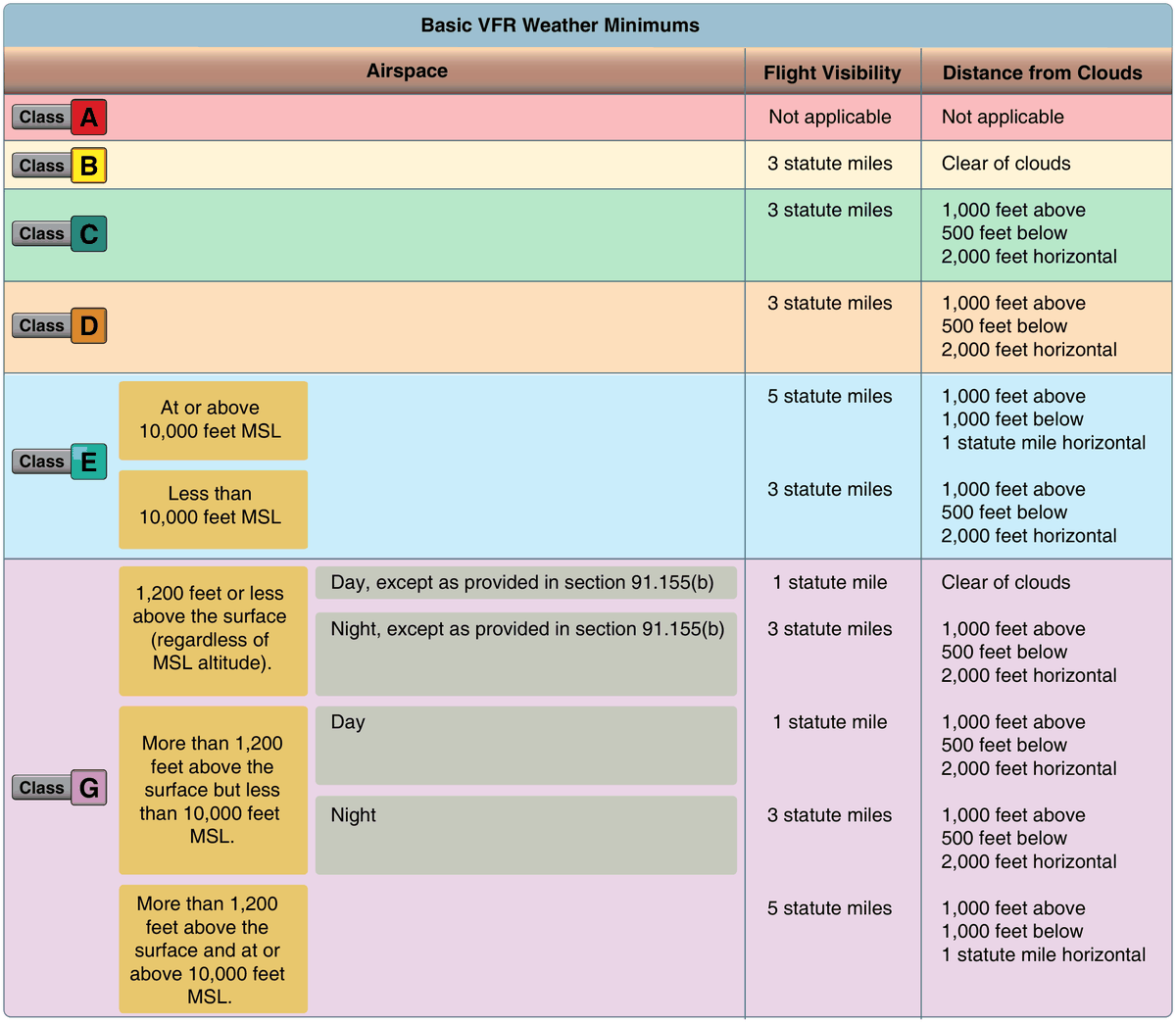
Three cases break away from the workhorse. Class B simplifies to 3 SM and clear of clouds — ATC is separating everyone, so you just need to see. Class E at or above 10,000 MSL tightens up to 5 SM, 1,000 below, 1,000 above, and 1 SM horizontal, because closing speeds are much higher up there. And Class G is the loosest — by day at or below 1,200 AGL, just 1 SM and clear of clouds — with the numbers stepping up at night and at higher altitudes (night is generally 3 SM and the 152 clearances).
| Airspace | Flight visibility | Distance from clouds |
|---|---|---|
| Class A | N/A — no VFR flight permitted | |
| Class B | 3 SM | Clear of clouds |
| Class C | 3 SM | 500 below, 1,000 above, 2,000 horizontal |
| Class D | 3 SM | 500 below, 1,000 above, 2,000 horizontal |
| Class E <10,000 MSL | 3 SM | 500 below, 1,000 above, 2,000 horizontal |
| Class E ≥10,000 MSL | 5 SM | 1,000 below, 1,000 above, 1 SM horizontal |
| Class G day, ≤1,200 AGL | 1 SM | Clear of clouds |
| Class G other cases | Increases (night generally 3 SM) | Generally 500/1,000/2,000 |
Self-check You’re at 4,500 ft MSL in Class E with 4 SM visibility, level and well clear of scattered cumulus. Legal for VFR?
Show answer
Yes. Below 10,000 MSL, Class E requires 3 SM and 500-below / 1,000-above / 2,000-horizontal. With 4 SM and good cloud clearance you meet both. Note that above 10,000 MSL the same flight would need 5 SM.
Transponder & ADS-B Out (91.215 / 91.225)
A Mode C transponder reports your pressure altitude to ATC radar; ADS-B Out broadcasts your GPS position, altitude, and identity to ground stations and nearby traffic. The rules for where each is required overlap heavily, and it’s cleanest to learn them together. You need a Mode C transponder and ADS-B Out in and around the busiest airspace, and generally up high:
That last exception matters: transponder/ADS-B is required at or above 10,000 ft MSL, except when you’re within 2,500 ft of the ground — so flying at 10,500 MSL over 9,000-ft terrain (i.e. only 1,500 ft AGL, within 2,500 AGL) doesn’t trigger the requirement on that basis alone. The Mode C veil is a 30 NM ring drawn around each Class B primary airport, extending from the surface upward: inside it, you need the equipment even in the Class E or G that lies beneath the Bravo shelves.
Pressure altitude feeds the box Your transponder reports pressure altitude, not indicated. If you’re curious what your Mode C is squawking versus what you read on the panel, work it out with the pressure altitude calculator.
Speed limits (14 CFR 91.117)
Airspace also caps how fast you may fly, to keep closing speeds manageable where traffic converges. Three limits cover almost every situation you’ll meet in light aircraft:
The broad one is 250 KIAS below 10,000 ft MSL — it applies almost everywhere in the low-altitude environment. Two tighter limits protect the terminal environment: 200 KIAS when flying beneath the lateral limits of a Class B shelf (or through a published VFR corridor that threads the Bravo), and 200 KIAS within 4 NM of the primary airport of a Class C or Class D at or below 2,500 ft AGL. Most trainers never approach these numbers, but they’re standard checkride fare and they matter the day you fly something faster.
Why 200 under the shelf The airspace under a Bravo shelf is often thin and packed with VFR traffic squeezing beneath the controlled airspace. Capping speed at 200 KIAS there keeps that funnel survivable. The same reasoning drives the 200-knot limit close to busy C/D airports near the ground.
Reading airspace on a sectional chart
All of this comes together on the sectional chart, where each class has its own line style and color. Learn these six marks and you can identify any airspace at a glance. The rule of thumb for the fuzzy vignettes: the airspace is on the shaded side of the fuzzy edge.
Two pairs are worth burning in because they’re easy to confuse. Solid magenta is Class C; dashed magenta is surface Class E — same color, totally different airspace and requirements. And solid blue is Class B while dashed blue is Class D. When you spot magenta, ask “solid or dashed?” before you decide what you’re looking at. The blue-versus-magenta vignettes only tell you the height of a Class E floor (1,200 vs 700 AGL), which in turn tells you how much Class G sits underneath.
Special-use airspace & TFRs
Layered on top of the A–G system is special-use airspace (SUA) — blocks set aside for activities that need to be separated from other traffic, plus temporary restrictions that come and go. These don’t replace the underlying class; they add rules within it. Here are the ones every pilot must recognize:
| Type | Chart prefix | What it means |
|---|---|---|
| Prohibited | P- | Flight is banned (security or national welfare, e.g. over sensitive sites). Never enter. |
| Restricted | R- | Invisible hazards to aircraft (artillery, missiles). Enter only with permission from the controlling agency when the area is “hot.” |
| Warning | W- | Same hazards as Restricted but starting 3 NM or more offshore, over international/domestic waters. |
| MOA | (named) | Military Operations Area — military training. VFR flight is legal, but exercise extreme caution when active. |
| Alert | A- | High volume of pilot training or unusual activity. No entry restriction — be vigilant. |
| Controlled Firing Area | CFA | Activity stops when radar/spotters detect aircraft, so it isn’t charted as a restriction. |
| National Security Area | NSA | Pilots are requested to voluntarily avoid; can be turned into a TFR (prohibition) when needed. |
Finally, Temporary Flight Restrictions (TFRs) are exactly what they sound like: short-lived blocks of restricted airspace thrown up around wildfires, VIP movements, major sporting events, disaster areas, and space operations. They are published by NOTAM and can appear with little notice, so you must check for TFRs before every flight — a current, legal-yesterday route can be illegal today. A TFR bust near a VIP movement can end in an interception and a certificate action, so this is not optional homework.
Every flight SUA is on the chart, but TFRs are not — they live in NOTAMs. Pull an official briefing and check active TFRs before you fly, every time. “It wasn’t there last week” is not a defense.
Two worked routes, requirement by requirement
Now we run the whole system on two short scenarios — turning a position into a checklist of clearance, communication, equipment, weather, and speed, using the same class colors from every diagram.
Example 1 — VFR arrival into a Class C airport
You’re inbound to a Class C field at 3,500 ft MSL (about 2,500 AGL), 8 NM out, tracking toward the primary airport. Visibility is 6 SM with scattered clouds well above you. What does the airspace require?
| Requirement | How you satisfy it |
|---|---|
| Entry | Call approach and wait until they answer with your call sign — then two-way comm is established and you may enter. “Aircraft calling, standby” would keep you out. |
| Equipment | Class C requires a two-way radio, Mode C transponder, and ADS-B Out — confirm all three are on and squawking. |
| Weather | Class C below 10,000 MSL needs 3 SM and 500/1,000/2,000 cloud clearance. With 6 SM and clouds well above, you’re legal. |
| Speed | Within 4 NM of the primary at or below 2,500 AGL, hold 200 KIAS or less. At ~2,500 AGL and closing inside 4 NM, this applies — easy in a trainer. |
Verdict: establish two-way comms, confirm your Mode C and ADS-B, you meet the weather, and you keep it under 200 knots near the field. No clearance is needed — that’s a Bravo thing, not a Charlie thing.
Example 2 — a cross-country under a Class B shelf
Your route threads beneath a Class B shelf whose floor is 3,000 MSL; you plan to stay at 2,500 MSL, remaining under the Bravo. You’re also within 20 NM of the Bravo’s primary airport. Visibility is 4 SM.
| Requirement | How you satisfy it |
|---|---|
| Clearance | By staying below the shelf floor you’re not in Class B, so no Bravo clearance is required. Climb into the shelf and everything changes — you’d need “cleared into the Bravo” first. |
| Transponder/ADS-B | You’re within the 30 NM Mode C veil (surface up), so Mode C and ADS-B Out are required even though you’re outside the Bravo itself. |
| Speed | Beneath the lateral limits of a Class B shelf, the limit is 200 KIAS. Hold 200 or less through the funnel. |
| Weather | Under the shelf you’re in Class E (below 10,000): 3 SM and 500/1,000/2,000. With 4 SM you’re legal — but with little margin, so watch the trend. |
Verdict: legal to proceed under the shelf without a clearance, provided your transponder and ADS-B are active for the veil, you stay at or below 200 knots, and the visibility holds at 3 SM or better. The instant you’d climb into the Bravo, add “cleared into the Bravo” to the list.
Self-check In Example 2, if you climbed to 3,500 MSL — into the Bravo shelf — what new requirement appears, and what does not change?
Show answer
You now need an explicit ATC clearance (“cleared into the Class Bravo”) to be there, and your VFR minimum relaxes to 3 SM clear of clouds. What doesn’t change: you already had Mode C and ADS-B for the veil, and those are also required inside Class B — so the equipment box was already ticked.
Common mistakes & misconceptions
These are the airspace errors that catch nearly every student pilot — and several show up on checkrides and in pilot-deviation reports. Get ahead of them.
Myth “Talking to the tower means I’m cleared into the Bravo.” No. Class B requires the explicit words “cleared into the Class Bravo.” Radio contact alone — even a squawk code — does not authorize entry.
Myth “‘Aircraft calling, standby’ means I can enter Class C.” It does not. Two-way comm is established only when ATC answers with your call sign. Without it, stay clear.
Myth “Solid magenta and dashed magenta are the same airspace.” Solid magenta is Class C; dashed magenta is surface Class E. Same color, different class, different rules — always check solid vs dashed.
Myth “Class A stops at FL600, so FL600 is above it.” Class A includes up to and including FL600 — FL600 itself is inside Class A.
Myth “I only need a transponder inside Class B or C.” You also need it within the 30 NM Mode C veil (surface up), above B and C to 10,000 MSL, and generally at/above 10,000 MSL (except within 2,500 AGL).
Myth “VFR is banned in an MOA.” VFR flight through an MOA is legal — you just exercise extreme caution when it’s active. A Prohibited (P-) area is the one that bans flight outright.
Myth “Class G’s low minimums mean it’s fine to fly in.” 1 SM clear of clouds is a legal floor, not a safe target. Marginal-VFR scud-running in Class G is a top killer — fly your personal minimums.
Frequently asked questions
What are the classes of airspace in order?
From most to least controlled: Class A, B, C, D, E, and G. A, B, C, D, and E are controlled airspace; G is uncontrolled. There is no Class F in the United States. The stricter the class, the busier the traffic it protects and the more it demands of you to enter.
Do I need a clearance to enter Class B?
Yes. Class B is the only class that requires an explicit ATC clearance containing the words “cleared into the Class Bravo.” Establishing radio contact or receiving a transponder code is not enough — you must hear the word “cleared” before you enter.
What does “two-way radio communication established” mean for Class C and D?
It means the controller has replied to your radio call using your call sign. If you call in and ATC responds “N34567, standby,” communication is established and you may enter. If they say “aircraft calling, standby” without your call sign, it is not established and you must remain clear.
What altitudes does Class A cover?
Class A extends from 18,000 ft MSL up to and including FL600 (about 60,000 ft). It is IFR-only — no VFR flight is permitted — and requires an instrument rating and an ATC clearance. Above 18,000 ft everyone uses the standard altimeter setting of 29.92 inHg and reports altitude as flight levels.
Why is Class B called an upside-down wedding cake?
Because in cross-section its shelves get wider as you go up. A small core reaches the surface at the primary airport, and progressively wider rings sit above it, each with a higher floor. The result looks like a wedding cake turned upside down — widest at the top (near 10,000 ft), narrowing toward the ground.
What are the standard dimensions of Class C airspace?
Typically a 5 NM-radius inner core from the surface to about 4,000 ft AGL, surrounded by a 10 NM-radius shelf from 1,200 ft AGL up to 4,000 ft AGL. Class C surrounds airports with a control tower, radar approach control, and moderate traffic. Actual dimensions are tailored per airport, so read the chart.
What do the magenta and blue vignettes on a sectional mean?
They mark the floor of Class E airspace. A fuzzy magenta vignette means the Class E floor is at 700 ft AGL; a fuzzy blue vignette means it’s at 1,200 ft AGL. The airspace is on the shaded side of the fuzzy edge, and Class G fills the space below the floor.
What are the VFR weather minimums for each class?
Class B: 3 SM, clear of clouds. Class C, D, and E below 10,000 MSL: 3 SM with 500 below / 1,000 above / 2,000 horizontal (“3-152”). Class E at or above 10,000 MSL: 5 SM with 1,000 / 1,000 / 1 SM. Class G by day at or below 1,200 AGL: 1 SM, clear of clouds, with higher figures at night and higher altitudes. These are set by 14 CFR 91.155.
When do I need a transponder and ADS-B Out?
Inside Class A, B, and C; above the lateral limits of B and C up to 10,000 MSL; within the 30 NM Mode C veil around a Class B primary airport (surface up); and generally at or above 10,000 ft MSL, except when you’re at or below 2,500 ft AGL. The rules are in 14 CFR 91.215 and 91.225.
What are the airspace speed limits?
250 KIAS maximum below 10,000 ft MSL; 200 KIAS beneath a Class B shelf or in a VFR corridor through Class B; and 200 KIAS within 4 NM of the primary airport of a Class C or D at or below 2,500 ft AGL. These come from 14 CFR 91.117.
Can I fly VFR through a Military Operations Area (MOA)?
Yes. VFR flight through an MOA is legal, even when it is active — but you should exercise extreme caution because military aircraft may be maneuvering at high speed. Contact the controlling agency or Flight Service to learn whether the MOA is hot. By contrast, Prohibited (P-) areas ban flight entirely, and Restricted (R-) areas require permission when active.
How do I check for TFRs?
Temporary Flight Restrictions are published by NOTAM, not printed on the sectional. Get them from an official preflight briefing (for example 1-800-WX-BRIEF or an aviation weather/NOTAM source) before every flight, since they can appear on short notice around wildfires, VIP movements, sporting events, and disaster areas.
Keep going: drill entry rules and equipment with the airspace flashcards, tie the weather minimums to real reports in the METAR decoder, sort out the altitudes with the pressure altitude calculator, and browse the rest of the Classroom before you fly.